Why Clear Design Intent Matters in Mechanical Design
A CAD model can be geometrically correct and still be difficult to use.
The problem is often not the shape itself.
The problem is unclear design intent.
Design intent explains why a feature exists, not only where it is.
A hole may exist for fastening, locating, adjustment, inspection, or cable routing.
A slot may exist for tolerance compensation, assembly adjustment, or manufacturing flexibility.
A radius may exist for strength, tool access, safety, or stress reduction.
These details may look similar in geometry, but they can have very different engineering reasons behind them.
If that reason is not clear, the next person working with the model has to guess.
And guessing is rarely a good basis for manufacturing, assembly, inspection, or later modification.
Without clear design intent, later changes become risky.
Someone may modify a feature without understanding its function.
A supplier may interpret a detail differently.
A drawing may miss the critical information.
An assembly may become harder to build or inspect.
A small change can also create unexpected effects if the original relationships in the model are not clear.
This is why useful CAD models are not only clean geometries.
They should also preserve the logic behind the design.
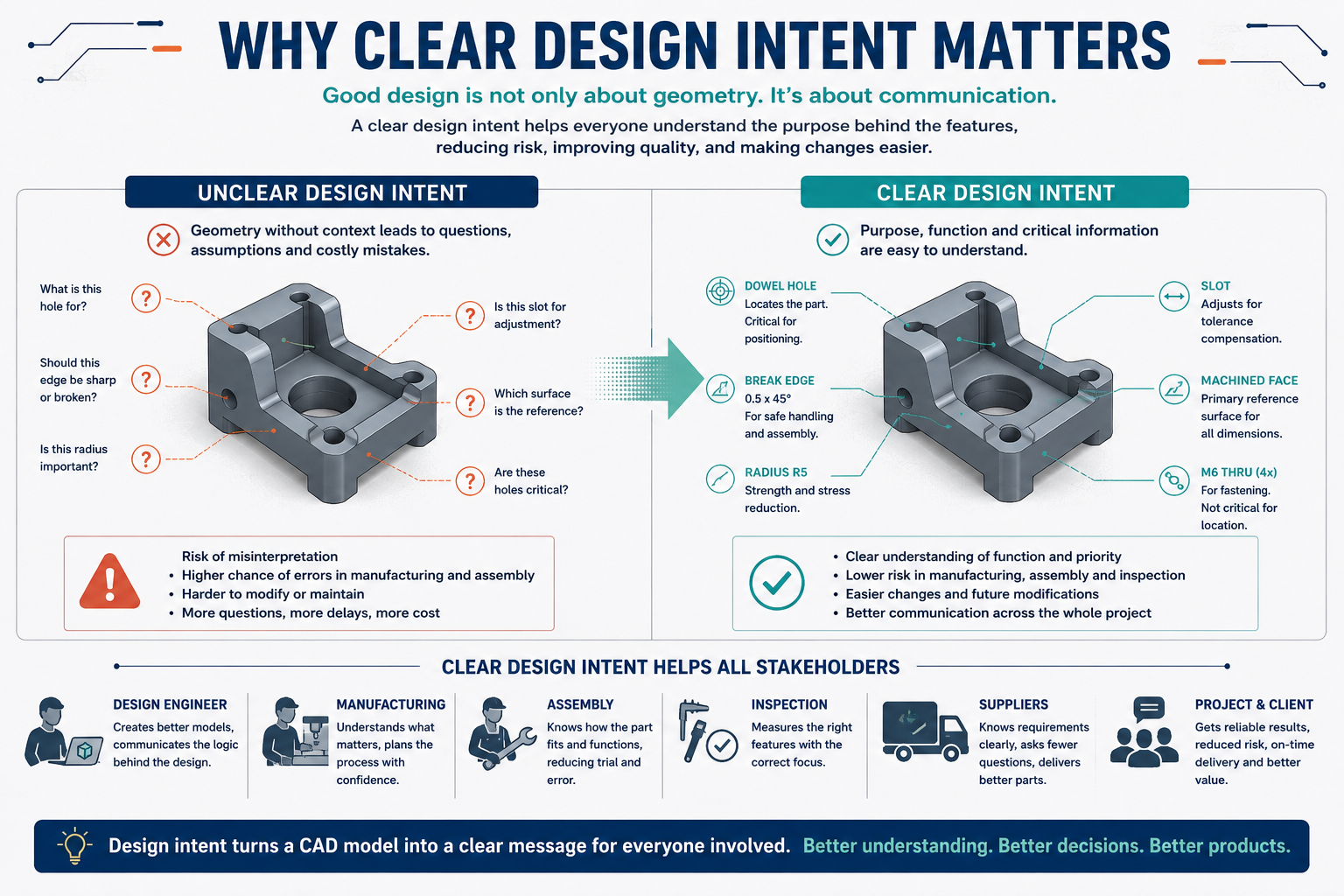
Before finalizing a model, I like to check:
- does each important feature have a clear function?
- would another engineer understand why it exists?
- can the model be modified without breaking the design logic?
- are critical relationships controlled intentionally?
- does the drawing communicate the same intent?
- does the design reduce guessing for manufacturing and assembly?
Good mechanical design is not only about creating the right shape.
It is also about making the engineering logic clear enough for other stakeholders, manufacturing, assembly, inspection, and future modification.