Why Small Design Decisions Matter in Manufacturing
Small design decisions often look insignificant in CAD.
- a hole position
- a chamfer
- a radius
- a tolerance
- a fastener direction
- a surface finish note
Each of these details may look minor during design.
But in manufacturing, inspection, assembly, and maintenance, they can create very real effects.
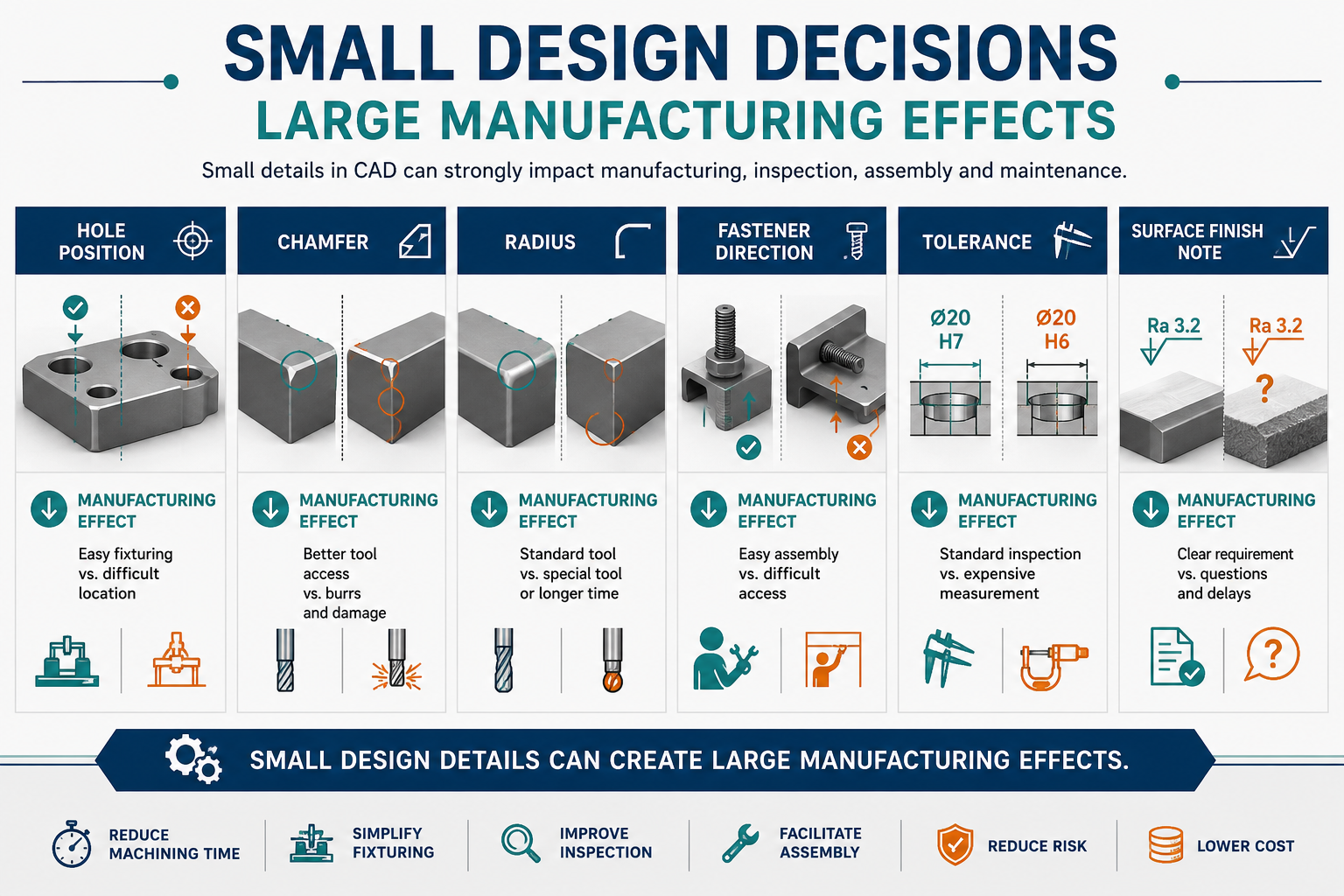
A hole position can decide whether a part is easy to fixture or difficult to locate.
A radius can decide whether a standard tool can be used or a special machining strategy is needed.
A fastener direction can decide whether assembly is straightforward or uncomfortable for the operator.
A tolerance can decide whether inspection is simple or unnecessarily expensive.
A surface finish note can decide whether a supplier understands the requirement or has to ask for clarification.
This is why manufacturing-focused mechanical design is not only about the main concept.
It is also about the small decisions that reduce friction later in the process.
Before finalizing a design, I like to check:
- can this feature be machined with standard tools?
- is the part easy to locate?
- is there enough access for assembly?
- can the feature be inspected?
- is this tolerance really needed?
- does this detail reduce risk, or add complexity?
Good design is often not the result of one big clever idea.
It is the result of many small decisions that make manufacturing easier, safer, and more reliable.